LECTURER OF ITALIAN AT THE UNIVERSITY OF GEORGIA

EDUCATION
I hold a Ph.D. and an M.A. in Italian Studies, as well as a Graduate Certificate in Global Medieval and Renaissance Studies from the University of Pennsylvania.
I also earned an M.A. in Italian Studies from Florida State University.
In addition, I earned a B.A. in Storia, an M.A. in Storia dal medioevo all’età contemporanea, and a B.A. in Lettere (cum laude) from Ca’ Foscari University of Venice.
TEACHING
I have taught courses at the University of Pennsylvania, Villanova University, and Florida State University, and I now teach Italian language and culture at the University of Georgia.
My teaching philosophy is rooted in the belief that language learning should be immersive, joyful, and intellectually stimulating. For this reason, I strive to transform the classroom into a participatory space where students actively experience Italian language and culture rather than simply study them through textbooks and grammar exercises. Teaching is at the center of my academic identity, and I continuously seek to enrich the learning experience through innovative materials, collaborative activities, and experiential learning.
A central component of my pedagogy is gamification and active student engagement. At the end of many lessons, students review course material through Kahoot!, a quiz-based competition that reinforces key concepts while creating a collaborative and energetic classroom atmosphere. I also regularly organize Jeopardy-style review games, team competitions, and other interactive activities designed to encourage participation, critical thinking, and collaboration.
These activities are brought together in a classroom “Olympics” at the beginning of the semester. During Spring 2026, the project became particularly meaningful because it coincided with the upcoming Milano-Cortina Winter Olympics. The classroom Olympics connected themes explored throughout the semester, including the 1960 Rome Olympics studied in my Italian language courses and the first recorded Olympic Games of 776 BCE discussed during our unit on Magna Graecia in my Italian soccer course. Through these shared activities, students encounter Italian history and culture as something living, dynamic, and deeply connected to everyday life.
I also strongly believe that food is one of the central pillars of Italian culture and an essential way of understanding everyday Italian life. Together with my students, I regularly organize cultural food events that recreate Italian traditions and social experiences inside the classroom. One example is Cannoli Day, during which students prepare and taste authentic Sicilian cannoli. Another recurring activity focuses on the Italian breakfast tradition. Rather than presenting only the stereotypical image of the Italian breakfast associated abroad with cappuccino and croissants at the bar, students experience the breakfast more commonly found in many Italian households: caffellatte with Italian biscotti. During these activities, students taste products such as Gocciole and Pan di Stelle, two of the most popular and beloved cookies in Italy.
One of the most appreciated classroom activities has been the preparation of salame al cioccolato, a traditional “poor” dessert likely originating in Northern Italy and still commonly served in trattorie across the country. Students prepare the dessert together during class and then share it during the following lesson, transforming the activity into both a cultural and communal experience. I also regularly bring Italian snacks such as Kinder Delice and Baci Perugina to class, connecting them to the historical and cultural topics discussed during the lesson.
These experiences allow students to engage directly with Italian culture in a concrete and memorable way. My goal is for students not simply to learn about Italy, but to feel immersed in it — intellectually, culturally, and emotionally.
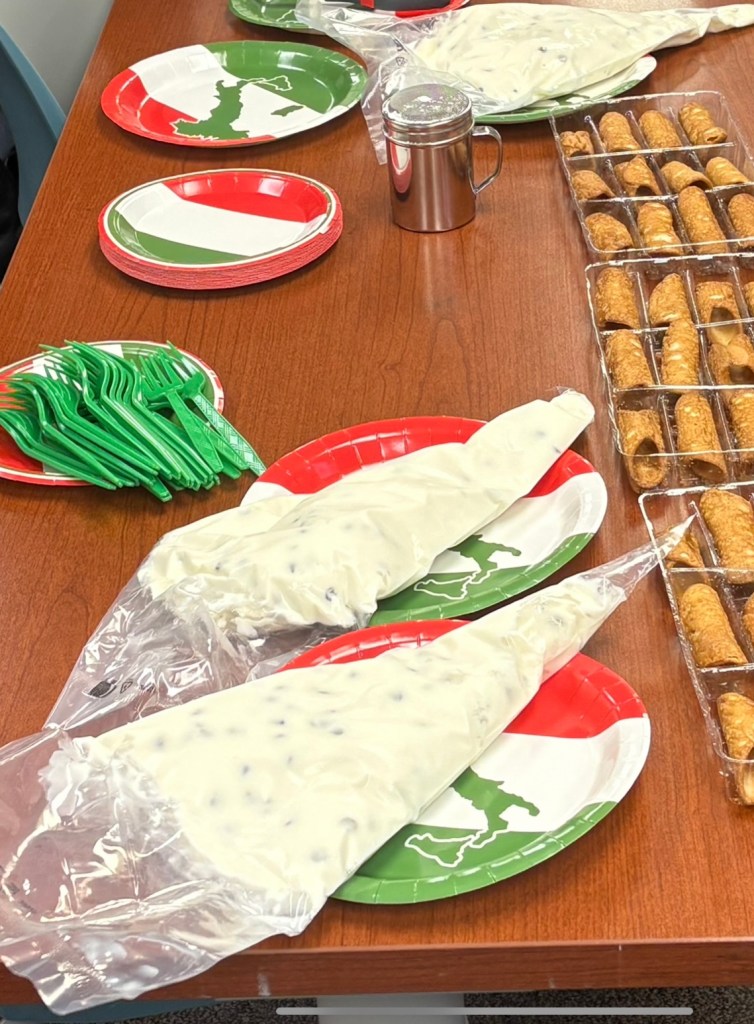
Over the course of my career, I have personally designed syllabi for a variety of courses that I have also taught, including Business Italian, Soccer Beyond the Field, Rome in Cinema, Italian for Reading Knowledge, and Italian Conversation. In particular, Soccer Beyond the Field is the first university course on Italian soccer offered in the United States. I taught the course at the University of Pennsylvania in Spring 2025 and at the University of Georgia in Spring and Summer 2026. I will also teach the course at the University of Georgia in Fall 2026 and Spring 2027.
SOCCER BEYOND THE FIELD
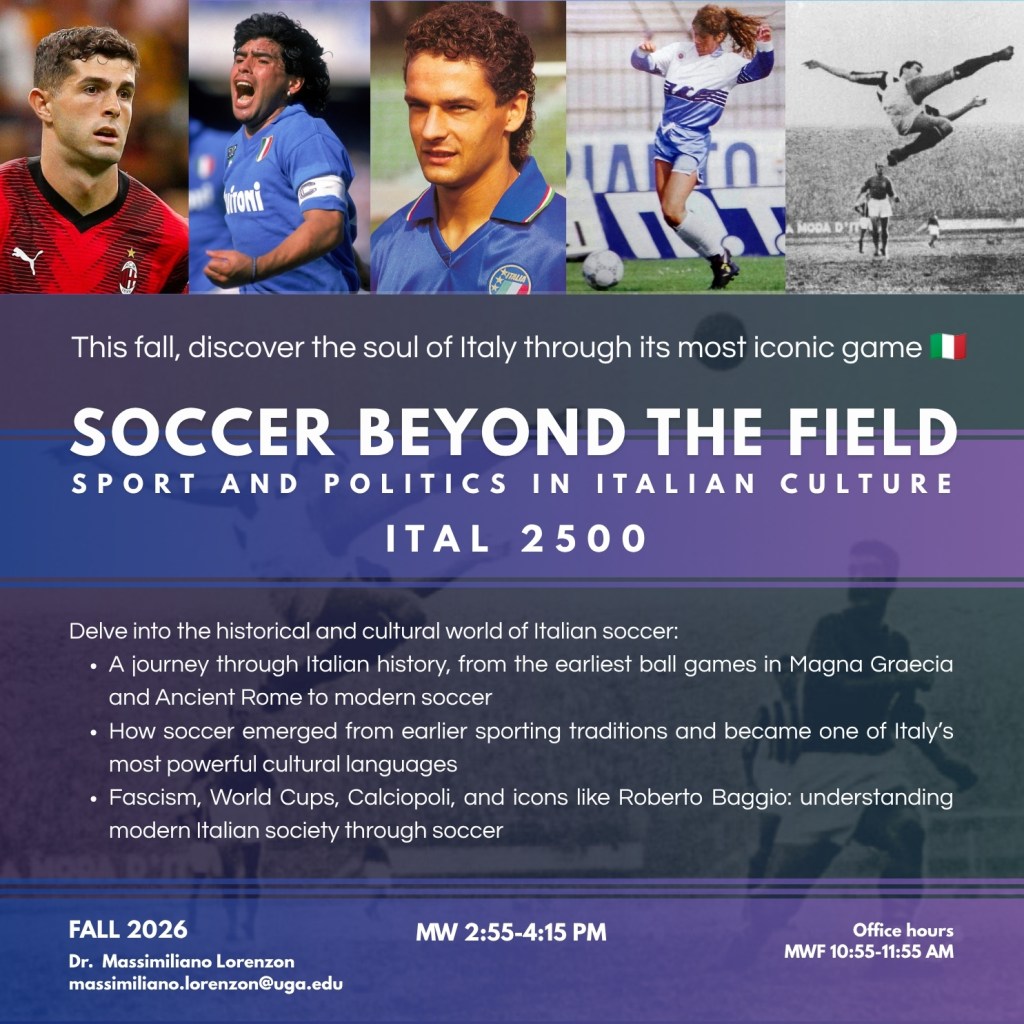
Poster for Soccer Beyond the Field, Fall 2026
The course approaches soccer not simply as a sport, but as a method for studying Italian history and society across the centuries.
We begin not in the twentieth century, but in antiquity. The course traces the Italian relationship with the ball back to Magna Graecia and the Greek Olympic tradition, then moves to ancient Rome and the concept of panem et circenses, where games functioned as tools of social control and political communication.
In the Middle Ages, we examine how games reflected social hierarchy, with different forms of play associated with different classes. During the Renaissance, we analyze Florentine Calcio Storico — a violent and aristocratic spectacle played by noble families and even by future popes. It was not the direct ancestor of modern soccer; in fact, it resembled rugby more than football. We also discuss the culture of competition and honor, including episodes such as Caravaggio’s fatal altercation during a ball game, which marked the turning point of his life and led to his exile from Baroque Rome.
The nineteenth century introduces Pallone col Bracciale, the most popular Italian sport of its time, long before soccer became dominant. Only at the end of the century does modern football appear in Italy.
At that point, soccer becomes the central focus of the course — the primary lens through which we examine modern Italian history.
The course dedicates three full weeks to Fascism, when soccer was institutionalized and stabilized, and when the modern Serie A and Serie B were formally established (first national championship season: 1929–1930). From there, we move through the twentieth century: the Economic Boom, the Years of Lead, the 1982 World Cup victory, the transformations of the 1990s, and the 1994 World Cup in the United States, with a full week dedicated to Roberto Baggio — the most extensively studied individual figure in the course.
We then examine Calciopoli (2006), the crisis of Italian football, and the “Balotelli generation,” analyzing how debates over immigration and national identity were reflected in public reactions to Mario Balotelli. Throughout the course, students observe how soccer and Italian society evolve in parallel: periods of economic prosperity (the 1960s and 1980s) correspond to footballing strength and international dominance; periods of instability (such as the 1970s or the post-2006 crisis) coincide with sporting and institutional turbulence.
Soccer does not exist outside society. It mirrors it.
The course also integrates experiential components connected to different historical periods. When discussing medieval Siena and the Palio, students taste panforte, a traditional Tuscan dessert. During our unit on Fascism and the 1930s, we discuss the invention of the moka (1933) — the device that democratized coffee consumption and transformed it from an elite ritual into a daily experience shared across social classes. On that occasion, students experience Italian coffee culture firsthand, including Pocket Coffee, a favorite among participants.
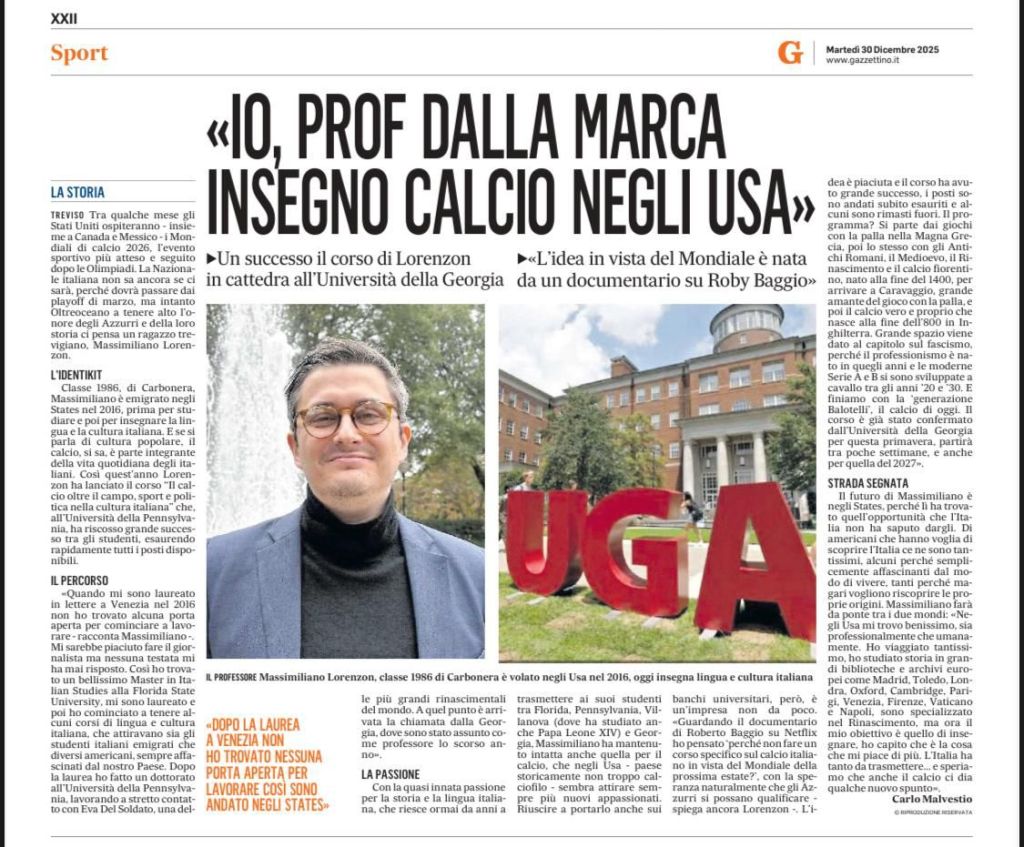
The course has also attracted media attention and was featured in articles published by Focus Storia, Il Gazzettino, and the Veneto edition of Corriere della Sera.
ITALIAN FOOTBALL AND MODERN ITALY: HISTORY, CULTURE, AND THE BEAUTIFUL GAME
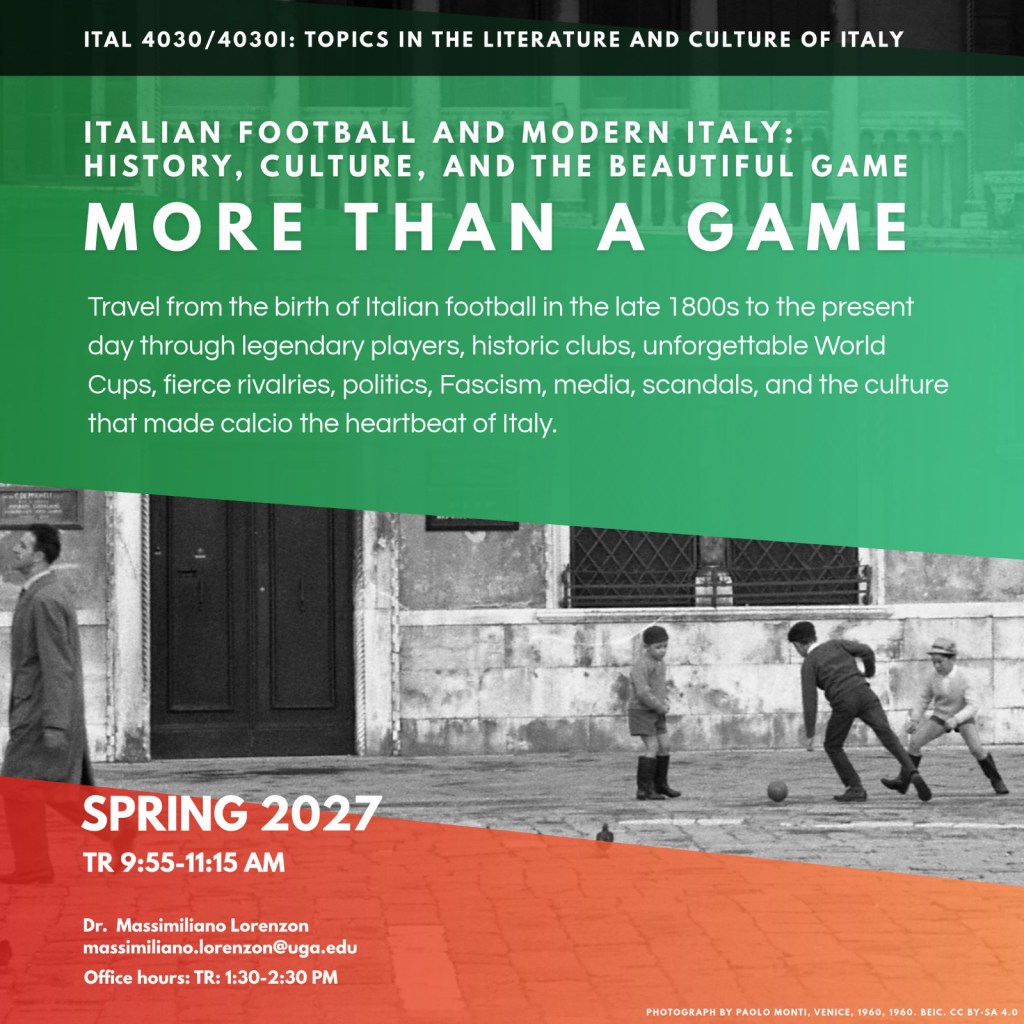
Poster for Italian Football and Modern Italy: History, Culture, and the Beautiful Game, Spring 2027.
In Spring 2027, Soccer Beyond the Field will take a new direction, with a stronger focus on the history of Italian football and its relationship with modern Italian history and culture.
The course will begin with calcio storico fiorentino before turning to the introduction of modern football to Italy in the late nineteenth century, the foundation of some of the country’s earliest and most iconic clubs—including Genoa, Juventus, and AC Milan—and the first Italian football championship in 1898. From there, students will follow the development of Italian football from its origins to the present day, exploring more than 130 years of Italian history through the lens of the beautiful game.
Football, however, will never be studied in isolation. Throughout the semester, the history of calcio will be placed within its broader historical and cultural context, allowing students to examine major transformations in modern Italy, from the turn of the twentieth century and Fascism to the postwar period, mass culture, television, globalization, and contemporary Italian society. In this way, football becomes a lens through which to explore Italian identity, politics, society, and culture.
The course will draw on a wide range of materials, including academic scholarship, magazine and newspaper articles, film—particularly Italian Neorealist cinema—music, poetry, and other forms of popular culture. These sources will allow students to examine how football both reflected and participated in the cultural and social changes that shaped modern Italy.
One of the major additions to the course will be its use of archival materials from UGA’s Special Collections Libraries. Students will have the opportunity to work directly with primary sources, including historical documents and audiovisual materials, bringing them into direct contact with the sources through which the history of modern Italy can be reconstructed and interpreted.
By tracing the history of Italian football from the late nineteenth century to the present, students will explore the political, social, and cultural history of modern Italy—and the extraordinary place that calcio has come to occupy within it.
RESEARCH
I am a co-editor of the international peer-reviewed journal Bibliotheca Dantesca, and I have contributed articles to the Italian history magazine Focus Storia. My work has also been published by Oxford University Press.
My research interests include sixteenth-century Italian culture; Second language acquisition; Italian literature from the Trecento to the Seicento; Latin literature (Classical, Medieval, and Renaissance); Italian and Byzantine history; Historical linguistics; Philology; and Italian cinema.
My Ph.D. dissertation investigates how the Italian vernacular was taught and learned in sixteenth-century Western Europe, with particular attention to who studied it and for what purposes.
For my dissertation, which is strongly based on archival sources, I conducted research in many of the major archives and libraries of Western Europe, including those of Madrid and Toledo, Venice, Florence, the Vatican, Naples, London, Oxford, Cambridge, and Paris.
I have presented my research at numerous international conferences in the United States, Scotland, Uruguay, and Italy on topics such as the integration of culture in Italian language instruction, sixteenth-century Italian pedagogy, and the Decameron as a source for fourteenth-century Florentine chronicles.
TEACHING EXPERIENCE
University of Georgia. 2025-present
Italian 2500E, Italian Culture – Soccer Beyond the Field, Summer 2027.
Italian 4030 and 4030I, Italian Literature and Culture – Italian Football and Modern Italy: History, Culture, and the Beautiful Game, Spring 2027.
Italian 2001 (Intermediate Italian I), two sections, Spring 2027.
Italian 2500, Italian Culture – Soccer Beyond the Field, Fall 2026.
Italian 1001 (Elementary Italian I), three sections, Fall 2026.
Italian 2500E, Italian Culture – Soccer Beyond the Field, Summer 2026.
Italian 2500, Italian Culture – Soccer Beyond the Field, Spring 2026.
Italian 2001 (Intermediate Italian I), Spring 2026.
Italian 1002 (Elementary Italian II), Spring 2026.
Italian 1002 (Elementary Italian II), three sections, Fall 2025.
University of Pennsylvania. 2020-May 2025.
Soccer Beyond the Field: Sport and Politics in Italian Culture, Spring 2025.
Business Italian, Fall 2024, Fall 2022.
Italian Conversation, Fall 2024, Spring 2024, Fall 2023.
Elementary Italian I, Summer 2024 (online).
Intermediate Italian II, Spring 2024, Spring 2023, Spring 2022, Spring 2021 (online).
Rome in Cinema: Representations of the Eternal City, Fall 2023.
Italian for Reading Knowledge, Summer 2023 (online).
Intermediate Italian I, Fall 2021, Fall 2020 (online).
Villanova University. 2022-2022.
Introductory Italian II, Spring 2022.
Florida State University. 2017-2019.
Italian Reading and Conversation, Summer 2019, Spring 2019, Fall 2018 (two sections)
Elementary Italian II, Spring 2019, Summer 2018, Spring 2018 (two sections).
Elementary Italian I, Fall 2017.
PUBLICATIONS
“Joanna of Austria and the Learning of Italian in the Sixteenth Century,” Notes and Queries, Oxford University Press, August 2026
“Teaching Italian in Italian: A Dialogue between Giacomo Castelvetro and Anna,” Notes and Queries, Oxford University Press, June 2026.
Review of “Atti degli incontri sulle opere di Dante. IV. De vulgari eloquentia – Monarchia,” Corrado Bologna and Francesco Furlan eds., Bibliotheca Dantesca, Vols. 7-8 (2026).
Review of “On Amistà: Negotiating Friendship in Dante’s Italy,” Elizabeth Coggeshall, Bibliotheca Dantesca, Vols. 7-8 (2026).
“A new Jacopo Corbinelli’s Annotated Printed Book,” Notes and Queries, Oxford University Press, January 2025.
Review of “Nel nome di Dante. Diventare grandi con la Divina commedia,” Marco Martinelli, Bibliotheca Dantesca. Vol. 3 (2020).
Review of “Cristoforo Landino. His works and thought”, Bruce McNair, Bibliotheca Dantesca. Vol. 2 (2019).
For Focus Storia:
“L’Italia del pallone”. Focus Storia 237 (2026): 8.
“Messa a fuoco”. Focus Storia 224 (2025): 75-79.
“Rivoluzione in classe”. Focus Storia 204 (2023): 22-27.
“Il brutto male”. Focus Storia 199 (2023): 86-91.
“Noi, ragazzi contro Hitler”. Focus Storia 196 (2023): 69-73.
“Il padre della lingua”. Focus Storia 171 (2021): 56-59.
“Monache per forza”. Focus Storia 164 (2020): 25-28.
“Smemorato e conteso”. Focus Storia 126 (2017): 106-109.
“Caccia agli antipodi”. Focus Storia 75 (2013): 32-36.
“Amicizie fatali”. Focus Storia 69 (2012): 96-100.
“Noi, ragazzi contro Hitler”. Focus Storia 68 (2012): 90-94.
“Affondate l’arcobaleno”. Focus Storia 62 (2011): 88-89.
“I fantasmi di Entebbe”. Focus Storia 59 (2011): 16-17.
“L’altra Cina”. Focus Storia, 2011 57 (2011): 14-15.
“Nuvolari, il mantovano volante”. Focus Storia 54 (2011): 100-107.
“Victor il selvaggio”. Focus Storia 53 (2011): 90-95.
SELECTED ACADEMIC HONORS AND AWARDS
Special Collections Libraries Teaching Fellows Program 2026, University of Georgia.
Certificate of Excellence in Teaching. Department of Francophone, Italian, and Germanic studies (University of Pennsylvania). May 2024.
Dante Society of America Presidential Service Award. Issued by The Dante Society of America. May 2024.
Penfield Dissertation Research Award. Academic year 2023/2024.
Graduate Certificate in Global Medieval and Renaissance Studies. Issued by the University of Pennsylvania. May 18, 2022.
Certificate of Excellence in Teaching. Department of Romance Languages (University of Pennsylvania). April 2022.
CONFERENCE PRESENTATIONS
“Teaching Italian in the Sixteenth Century: Early Traces of Active Learning.” Hospitable Classrooms for Language Learning and Creative Expression. The 98th Annual SAMLA Conference, hosted by the South Atlantic Modern Language Association. November 7, 2026.
“Learning Italian through Translation: Sixteenth Century Pedagogical Practices.” Translation as Performance: Navigating Transcultural Competence. American Association for Italian Studies (AAIS) 2025 Annual Conference. Philadelphia, March 13, 2025.
“Learning Italian Language and History through the song La nazionale by Lorenzo Baglioni.” Integrating Current Cultural Phenomena into Modern Language Classroom. The 56th Annual Northeast Modern Language Association (NeMLA) Convention. Philadelphia, March 8, 2025.
“From Yesterday to Today. Teaching Italian in the Sixteenth and Twenty-first Centuries: A Comparative Study”. Innovative Approaches to Equitable and Inclusive Pedagogy/Teaching Language and Content Courses, American Association of Teachers of Italian (AATI) Conference. Università degli Studi di Catania, Italy, July 6, 2023.
“The Canto XXVIII of Inferno and the Islamic Word”. Newberry Library 2022 Multidisciplinary Graduate Student Conference. Newberry Library, January 29, 2022. On Zoom.
“The Black Death of 1348: the Decameron as a Possible Source for Two Florentine Chronicles of the Trecento”. Interpretations, Appropriations, and Rewritings of Giovanni Boccaccio. 11th International Montevideana Conference. Universidad de la Republica, Uruguay, June 24, 2021. On Zoom.
“The Catholic Church and Venice in the Early Modern Period: History and Difference of Two European Conflicts”. Enemies in the Early Modern World, 1453-1789: Conflict, Culture and Control. The University of Edinburgh, Scotland, March 28, 2021. On Zoom.
“The Black Death of 1348: the Decameron as a Possible Source for Two Florentine Chronicles of the Trecento”. Apocalyptic Landscapes. From Antiquity to COVID-19. French and Italian Graduate Society (FIGS). University of Pennsylvania, March 20, 2021. On Zoom.
MEDIA COVERAGE
Carlo Malvestio. “Io, prof dalla Marca insegno calcio negli Usa.” Il Gazzettino, December 30, 2025. Article on Massimiliano Lorenzon.
LA 9 (Italy), October 2012. Television appearance as journalist.
LANGUAGES
Native speaker of Italian and Venetian; full command of English; full reading competence in French, Spanish, and Latin; basic reading knowledge of German.
GET IN TOUCH
Read my weekly articles on Italian history and my fiction writing: https://massimilianolorenzon.substack.com/

